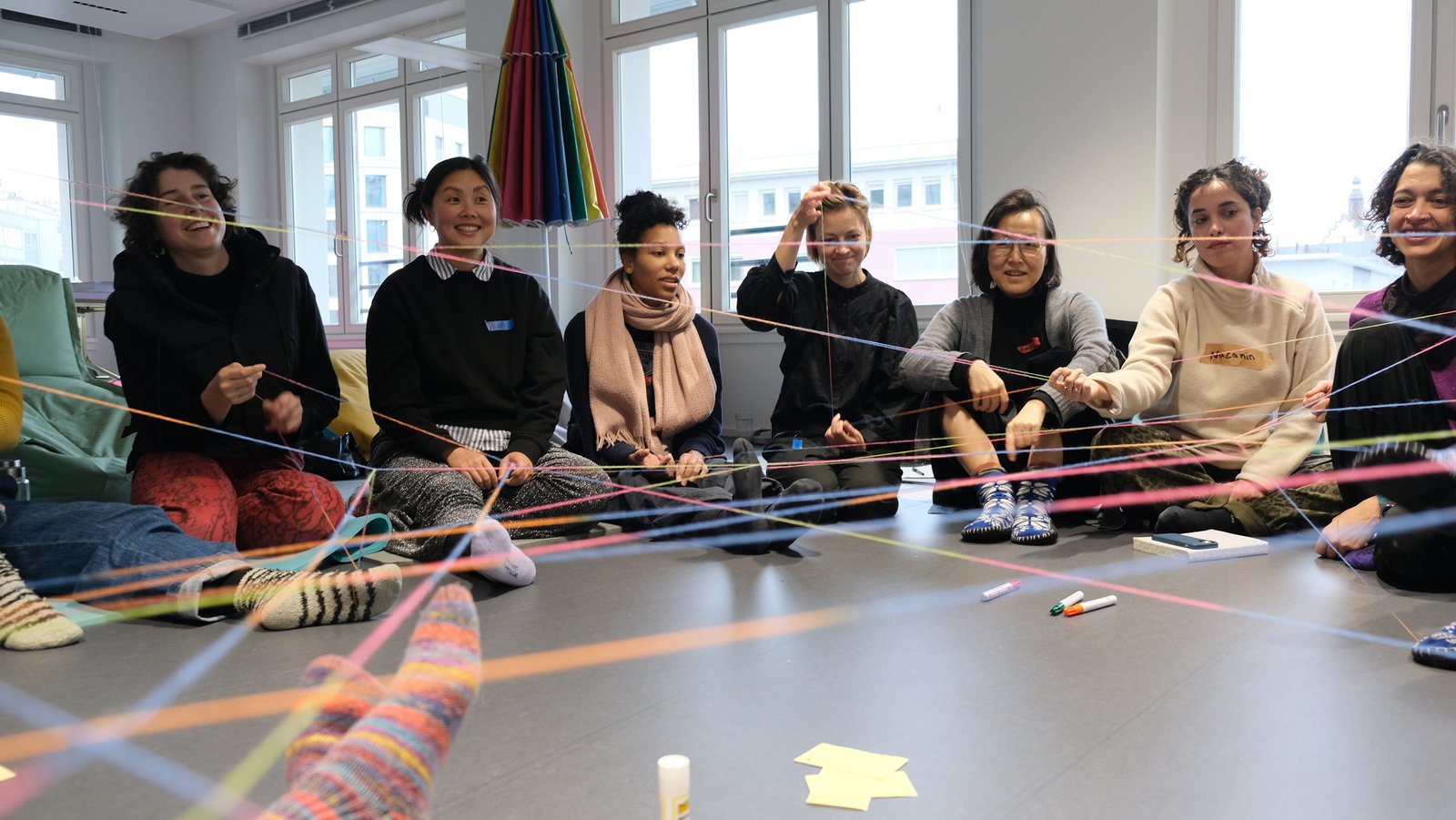
The formats range from compact impulse workshops to training courses lasting several days. Two to three sessions spaced 2-3 weeks apart have proven particularly effective for in-depth training courses, as they allow for individual work phases between training sessions. We are happy to coordinate the content, scope, and focus of the training courses individually with you or your institution. If you are interested, please do not hesitate to contact us.
We bring many years of experience from various areas of the independent art and culture scene – from project development and self-organized structures to work at the intersection of art, education, and society. Our training courses combine practical knowledge with reflective perspectives on the conditions of artistic work.
For several years, we have also been advising and supporting artists in peer-to-peer formats, individual coaching, and group offerings. In doing so, we create spaces for exchange, reflection, and further development.
This training course is aimed at institutions (e.g., museums, theaters, art associations) that want to provide artists, art educators, or cultural professionals with practical knowledge for developing and implementing their own projects.
Over two days, participants learn how to develop a compelling concept from an idea for an art education project and how to research and apply for appropriate funding. The training course combines theoretical input with application-oriented exercises and is aimed in particular at people who are at the beginning of their professional practice or who wish to gain further qualifications in a specific area.
Contents of the training course:
- Basics of concept development in art education
- Introduction to funding logic and common application procedures
- Financial planning, cost calculation, and funding budgets
- Overview of suitable legal forms and project structures
In the practical part, participants work in pairs to develop their own education concept based on a curatorial or institutional framework (e.g., an exhibition or a current topic of the institution). The concepts will be presented and discussed together in the second part of the training.
Optionally, one of the concepts can be selected by the organizing institution, further developed, and implemented as part of a pilot project. A budget should be available for this purpose.
Target group:
Freelance artists, art educators, students of art or art education, and other cultural professionals interested in project-based work in the field of education.
Format & scope:
Two-day training course (can also be conducted as a block or at intervals), adaptable to the target group and institutional context.
Music moves people, music connects people, music is a powerful means of expression. When working with young people, these are valuable elements for strengthening creativity, self-empowerment, and cohesion on the one hand, and for giving young people a platform to send their message on the other.
In this seminar, we will look at how music can become a fundamental and conceptual element in an extracurricular cultural education project and connect with the realities of young people's lives. Using the feminist rap project SISTER*QUEENS as an example, we will discuss approaches to content development and outline successful project planning.
At SISTER*QUEENS, girls have been writing their own rap songs together since 2016, voicing their concerns and perspectives through rap. In addition to empowerment, the project is also about growing beyond one's own limits: girls* who were shy at first are now standing confidently on stage after a few months. Rap artists Sister Fa, Ebow, Leila Ey, ALICE DEE, and Haszcara have already participated.
In the workshop, we will address the following questions
- How can I motivate and find participants for my music project?
- How can collective music production be organized?
- How can process and results orientation be balanced effectively?
Topics include:
- Music production with young people without prior musical knowledge
- Feminist approaches in music education
- Methods for creative writing and rapping
Collective practices in social contexts: methods for collaborative work
For over ten years, the members of Peira have been working on artistic projects that are rooted in social and socially relevant contexts. Our practice is characterized by heterogeneous collaborations, multiple authorship, and continuous engagement with the conditions of collaborative work.
But artistic collaboration on equal terms in social contexts requires more than just a good idea—it requires sensitivity, methodological awareness, and structural clarity. In this workshop, we share experiences from our practice, present proven methods, and open up a space for collective knowledge exchange.
Workshop objective:
Over the course of two days, participants will work together to develop a “methodology handbook” – a collection of approaches, reflections, and tools related to working in and with communities of support. The methodology handbook will be created as a collective document in a shared knowledge process and will be made available to all participants at the end of the workshop.
Key topics and workshop formats:
- Collective authorship and decision-making processes
- Working with target groups/communities
- Framework conditions and clarification of roles
- Reflection on existing projects
- Practical methods (input, trial and error, adaptation)
Working method:
The workshop is designed to be dialogical, experience-based, and collaborative. In groups or changing small groups, participants work on individual method sheets, which are then compiled into a joint method book.
Depending on the group size and setting, different formats are used:
- Station work / “circuit training” with changing tasks
- Work assignments with open or formative guidelines
- Short inputs (texts, videos) as common starting points
- Presentations and discussions of specific projects
- Experimental phases for testing methods from our practice
Format & scope:
Two-day workshop, can also be used as a creative lab, continuing education module, or accompanying workshop format.
Target group:
Artists, mediators, cultural actors, and project developers who work or would like to work in social or participatory contexts.